
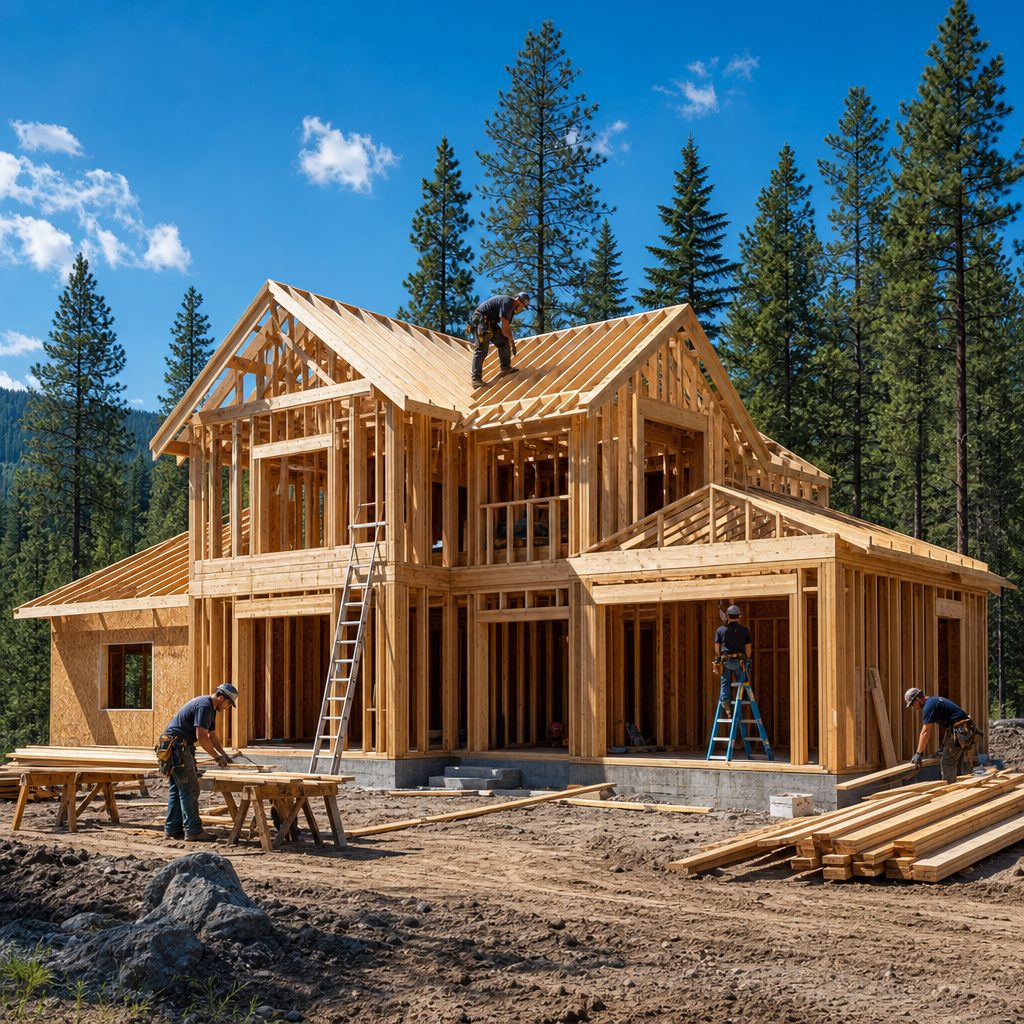
Building in Benewah County Is Not Like Building in Boise
If you've done research on new home construction in Idaho and landed on cost estimates or timelines from Boise-based sources, set those numbers aside. Benewah County — the county seat is St. Maries — operates at a different pace, with different trade availability, different climate demands, and a permitting process that reflects a smaller, rural jurisdiction.
None of that is a complaint. After 20 years of building new homes in this county, I've come to appreciate the way things work here. But if you're planning a custom home build in the St. Maries area without understanding the local realities, you'll end up frustrated by surprises that weren't surprises at all — they're just how things work here.
First: Understand the Land
Before you hire anyone, before you finalize a floor plan, get clarity on your land:
Soil type and bearing capacity. Benewah County has significant areas of clay-heavy soil, particularly in lower-lying areas near waterways. Clay soil has poor bearing capacity when saturated — and it is saturated for long periods here. Your foundation design depends heavily on a soils test. A percolation test may also be required if you're on a septic system (most rural properties are).
Slope and drainage. Northern Idaho terrain is not flat. Building on a sloped site changes everything: foundation type (stem wall vs. daylight basement vs. slab), site work cost, drainage engineering, and potentially retaining walls. Sloped sites are common and absolutely buildable — but budget for the site preparation accordingly.
Access. County road access, driveway permitting, and culvert requirements are handled by the Benewah County Road Department. If your parcel requires a new road or driveway crossing over a drainage ditch, you'll need a driveway approach permit before construction begins.
Utilities. Water and sewer availability depends on location. City of St. Maries water and sewer service covers the city limits. Rural properties are typically on private well and septic. If you're on well and septic, those systems require separate permits and design by a licensed engineer. Well drilling and septic design add time and cost to the pre-construction phase.
The Permit Process in Benewah County
New home construction in Benewah County requires a building permit from the county building department. The process:
- Site plan and floor plans submitted to the building department. Plans must be drawn to scale and show foundation type, framing layout, roof pitch and structure, window and door locations, and mechanical systems.
- Plan review. Benewah County reviews for compliance with the Idaho Residential Code. Plan review for new construction typically runs three to five weeks. Complex plans or plans with revisions may take longer.
- Permit issued. Once approved, the permit is issued and construction can begin.
- Required inspections during construction:
- Foundation/footing inspection (before pouring concrete)
- Framing inspection (before insulation or drywall)
- Rough mechanical inspection (plumbing, electrical, HVAC rough-in)
- Insulation inspection
- Final inspection
Missing an inspection — or having inspectors find work that was covered before inspection — means opening up walls or floors. It happens. We manage the inspection schedule so you don't have to track it yourself.
Frost Line and Foundation Requirements
This is the part that surprises people who are accustomed to building in warmer climates.
Benewah County records approximately 118 freeze days per year. The frost line depth — the depth below which the soil stays above freezing — is 24 to 36 inches, depending on elevation and site conditions. Footings must be placed below the frost line to prevent frost heave, which is what happens when frozen soil expands and pushes foundations out of the ground.
This means every foundation in Benewah County requires footings that go deep. A full basement or crawl space foundation naturally places footings well below frost depth. Slab-on-grade is less common here because slabs require significant insulation engineering to prevent frost heave on the perimeter — it's doable, but it adds design complexity.
At higher elevations or in exposed locations, frost line depth increases. If you're building on a ridge or in a location with limited snow cover (snow acts as insulation), plan for deeper footings.
Snow Load Planning
Benewah County averages 67 inches of snowfall per year. St. Maries sits at approximately 2,100 feet elevation; higher sites in the county see more.
Snow load — the weight of accumulated snow on a roof — is a structural design requirement, not an optional consideration. The Idaho Residential Code specifies minimum ground snow load values by county. Benewah County falls in the 50–70 psf range depending on location within the county.
What this means for your home:
- Roof pitch matters. Steeper pitches shed snow faster and reduce accumulated load. Low-slope roofs in Benewah County require more structural reinforcement.
- Roof span matters. Wider roof spans require larger structural members to carry the load.
- Overhangs and covered porches require their own load calculations.
Your house plans need to be stamped by a structural engineer who has worked with Idaho snow loads. A plan stamped by an Arizona or California engineer who didn't account for Northern Idaho snow load conditions is a problem — and the Benewah County building department will catch it.
Building Season in Northern Idaho
You can build year-round in Northern Idaho, but not everything happens at the same pace in every season.
Best time to break ground: Spring (April–May) or early summer (June). Soil conditions are best after the ground thaws but before the wet season has dried out enough to work without rutting up the site.
Foundation and site work: Done as soon as the ground thaws and conditions allow — typically March to November. Concrete can be poured in cold weather with proper admixtures and blanket curing, but it's more complicated and expensive.
Framing and roofing: Works year-round. Framing crews work through the winter; getting the building dried in (roof and windows installed) is the priority before winter.
Interior work (electrical, plumbing, drywall, finish): Works year-round — interior conditions are controlled once the building is dried in.
Schedule realistically. From breaking ground to move-in, a custom home in Benewah County typically runs 10 to 16 months, depending on scope and whether any weather or supply chain delays hit. Don't plan your move date for the same season you break ground.
What a New Home Costs in Northern Idaho
Custom home construction in the St. Maries and greater Benewah County area typically runs $175 to $325+ per square foot, finished. That range is wide because scope varies enormously:
- Lower end ($175–$220/sq ft): Builder-grade finishes, efficient floor plan, existing site access, no major site prep complications
- Mid-range ($220–$275/sq ft): Upgraded finishes, some site work, vaulted ceilings or custom roof lines
- Upper range ($275–$325+/sq ft): High-end finishes throughout, significant site prep (slope, clearing, retaining walls), custom architectural details, full basement
These are real Northern Idaho numbers, not adjusted from national averages. Trades in this area command rates reflecting the smaller labor pool and the distance from major supply hubs in Spokane or Coeur d'Alene.
Site work — clearing, grading, septic system, well drilling, driveway — is additional and can add $20,000 to $80,000+ depending on your land conditions.
Start With a Site Visit
If you have land in Benewah County and are seriously considering a new home build, the best first step is a site visit and conversation. We'll look at the property, talk through what makes sense for the site conditions, walk through the permitting process, and give you a realistic picture of what a build project looks like from start to finish.
Call (208) 582-8733 or reach us through the contact page.
Frequently Asked
Questions
How long does it take to get a building permit in Benewah County?
Plan review for new home construction typically runs three to five weeks, assuming your plans are complete and don't require revisions. If the building department requests corrections, expect additional review time. We manage the plan submission and follow-up so you're not tracking down the building department yourself.
Can I be my own general contractor for a new home build in Idaho?
Legally, yes — Idaho allows owner-builder permits for your primary residence. Practically, it's extremely difficult if you don't have existing relationships with licensed subcontractors and experience coordinating construction schedules. We've seen owner-builder projects stretch twice as long and come in over budget due to coordination failures. Most people who start as their own GC eventually hire one partway through.
Does Vandenberg Construction do design services for new home construction?
Yes. We offer design services including 2D floor plan development and 3D modeling so you can see exactly what you're building before we pull a permit. Design fees are applied toward the build contract if you proceed with Vandenberg Construction.
What is the difference between a manufactured home and a custom-built home for Benewah County purposes?
Manufactured homes (HUD-code homes) and modular homes are built off-site and set on permanent foundations — they have a different permitting and inspection path than site-built custom homes. Vandenberg Construction builds site-built custom homes. If you're considering manufactured or modular, that's a different conversation with different contractors.