
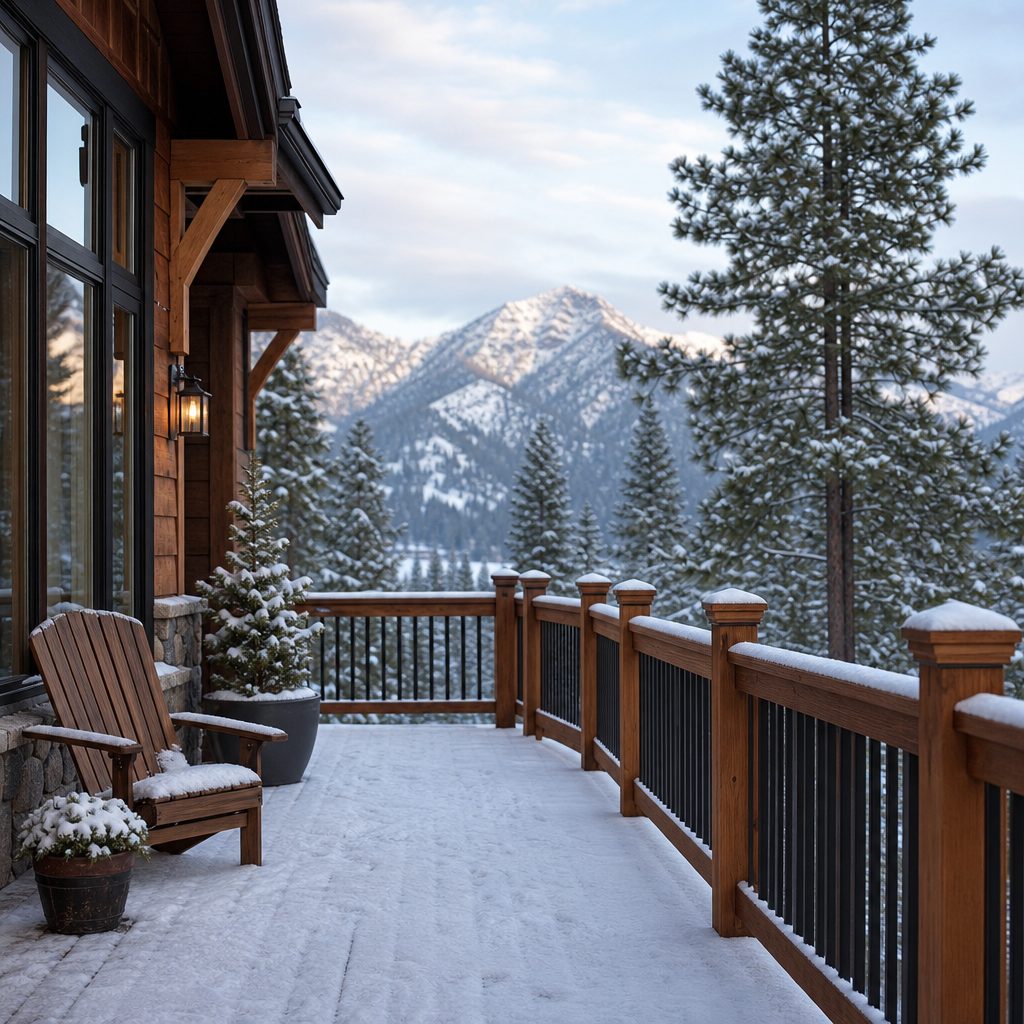
Why Deck Building in Northern Idaho Is a Structural Problem
First
A deck in Scottsdale is a shade structure. A deck in Northern Idaho is a structural system that's going to sit under 67 inches of snow every winter while experiencing 118 freeze-thaw cycles per year.
That's not an exaggeration. Those are Benewah County's actual averages. Kellogg and the Silver Valley see similar snow totals at higher elevation. And those conditions have real engineering consequences for how a deck is designed, what materials survive, and how posts, footings, and ledger connections need to be detailed.
Here's what 20 years of deck building in Northern Idaho taught us.
Frost Line: The Non-Negotiable Starting Point
Every deck post sits on a footing. Every footing must be below the frost line, or the deck will move — lifted and dropped by freeze-thaw cycling until the ledger pulls away from the house, the decking boards crack, or the whole structure becomes a tripping hazard.
In Benewah County, frost line depth is 24 to 36 inches, depending on elevation and site exposure. Shoshone County (Kellogg, Pinehurst) and Kootenai County (Coeur d'Alene) have similar or slightly deeper requirements at higher elevations.
What this means in practice: post footings for a Benewah County deck need to be poured concrete, minimum 36 inches deep, with a diameter sized to the post load. Pre-cast pier blocks — the kind you see at big-box home improvement stores, rated for mild climates — are not appropriate here. They sit on the surface of the ground and will move with the frost.
Any deck company that quotes you without discussing footing depth is skipping the most important question.
Snow Load: How Much Weight Is on That Deck?
The Idaho Residential Code assigns ground snow load values by county. Benewah County falls in the 50 to 70 psf (pounds per square foot) range. At the upper end, that's a 3,500-pound load on every 50 square feet of deck surface — roughly the weight of a large pickup truck.
That load has to travel somewhere: through the decking boards, into the joists, through the beam, down the posts, into the footings. Every connection in that path has to be designed and built to carry it.
What this affects:
- Joist sizing and span. Deeper joists, shorter spans, or both, relative to what you'd see in a lower-snow-load area.
- Post sizing. 4x4 posts that work fine in Phoenix won't work at snow loads Benewah County sees for large spans or tall decks.
- Ledger connection. The ledger — the board bolted to your house where the deck attaches — carries the snow load on the inboard half of the deck. That connection needs lag bolts or structural screws of specific size and spacing, per the IRC prescriptive table.
- Railing and guardrail. Guardrail posts need to resist lateral load from someone falling against them plus accumulated ice and snow. Post footings in the decking need to be sized accordingly.
A deck built without snow load engineering either fails over time or fails all at once. We've been called to replace decks that were visibly sagging three winters after another contractor built them — always the same story: no footing depth, undersized joists, lag bolts instead of structural screws at the ledger.
Does a Deck in Northern Idaho Require a Permit?
In Benewah County, yes — if the deck is over 30 inches above grade or larger than 200 square feet, a building permit is required. This mirrors the Idaho Residential Code threshold.
The permit process requires:
- A site plan showing deck location relative to property lines and the house
- A framing plan showing joist layout, beam spans, post locations, and footing sizes
- Material specs (lumber species and grade, hardware specs, decking material)
Benewah County building department reviews the plan for code compliance and issues the permit. Inspections are required at footing (before concrete), framing (before decking), and final.
Kootenai County (Coeur d'Alene) has similar requirements but higher volume — expect plan review to run three to five weeks rather than two to three.
We pull the permit on your behalf. You don't deal with the building department directly.
Material Selection for Northern Idaho Conditions
This is where most of the homeowner decisions live — and where the wrong choice costs you significantly in maintenance and lifespan.
Pressure-Treated Lumber (the frame)
The deck frame — posts, beams, joists, ledger — should be pressure-treated lumber rated for ground contact where in contact with soil or concrete, and above-grade rated PT elsewhere. In Northern Idaho, we spec ACQ or CA treated lumber. Do not use the green-tinted legacy CCA-treated wood salvaged from older structures — it's not produced for residential use anymore, and its arsenic content creates disposal and health considerations.
PT lumber is structurally appropriate for Northern Idaho framing. It handles moisture well and doesn't rot when properly detailed (adequate ventilation, no standing water traps, proper drainage slope).
Decking Surface
Options
Pressure-treated decking: Most affordable. Works fine in Northern Idaho if you don't mind the maintenance cycle (clean, stain, and seal every 2–3 years). PT tends to check (develop surface cracks) and cup over time as it dries. Install with gaps and crown up to account for this.
Western Red Cedar or Redwood: Beautiful, naturally rot-resistant, splinter-resistant compared to PT. Higher cost, similar maintenance cycle to PT. Cedar and redwood are softer than composite and dent more easily — worth it for the aesthetic in most cases.
Composite decking (Trex, TimberTech, Fiberon): The premium choice for low maintenance. Composite handles freeze-thaw cycles well, doesn't split or warp like wood, and requires annual cleaning rather than staining or sealing. Hidden fastener systems make for a clean look without visible screw heads. The trade-off: higher upfront cost and a different aesthetic than natural wood — some homeowners love it, some don't. In Northern Idaho, composite holds up exceptionally well.
What we don't recommend: Exotic hardwoods (IPE, Ipe, Garapa) are popular in warmer climates and are durable, but in Northern Idaho's freeze-thaw environment the dense grain can check badly. We've seen IPE decks locally that look rough after three winters.
Hardware and Fasteners
This is not a place to cut cost. All structural connectors — joist hangers, post caps, ledger hardware — should be hot-dipped galvanized or stainless steel, rated for use with ACQ-treated lumber. Standard zinc-plated hardware corrodes rapidly in contact with ACQ's preservatives and in Northern Idaho's wet climate. Corroded joist hangers are a structural failure waiting to happen.
Deck screws should be stainless steel or hot-dipped galvanized coated (not electrogalvanized). For composite decking, use the fastener system specified by the decking manufacturer — using off-brand fasteners voids the warranty on most composite products.
Design Considerations for Northern Idaho
Decks
Slope for drainage. Decks in heavy-snow climates need to drain when snow melts. Build a slight slope away from the house (1/8 inch per foot minimum) so water doesn't pond on the deck surface or back up against the ledger.
Ledger flashing. The ledger-to-house connection is the most common failure point for water intrusion. Flashing must be installed per code — integrated with the house water-resistive barrier and designed to shed water away from the house framing, not trap it. This is especially critical in Northern Idaho where repeated freeze-thaw cycles will exploit any gap in the flashing.
Railing height. Idaho code requires a 36-inch guard height for decks up to 30 inches above grade, 42 inches for decks higher than 30 inches. In Northern Idaho, taller railings make sense from a safety standpoint in winter when the snowpack changes the effective height of the deck relative to surrounding grade.
Under-deck space. On elevated decks, consider how snow will land and accumulate under the deck. An uncovered space under a high deck can develop significant snow buildup against the foundation — design the understructure so that area drains properly.
What a Deck Costs in Northern Idaho
A straightforward ground-level or low-elevation pressure-treated deck in Benewah County typically runs $55–$85 per square foot, including permitting, footings, framing, decking, and railings.
Composite decking adds roughly $15–$25 per square foot to the surface material cost.
Elevated decks, complex designs (multiple levels, stairs, built-in seating), or sites requiring significant site prep cost more — sometimes significantly. A 600-square-foot multi-level composite deck with covered section and exterior stairs can run $70,000–$100,000 all-in.
The permit cost in Benewah County is based on construction valuation — typically $200–$500 for a residential deck permit.
Ready to Talk About Your Deck?
If you're planning a deck in St. Maries, Coeur d'Alene, Kellogg, Harrison, or anywhere in Northern Idaho, give us a call at (208) 582-8733 or reach us on our contact page. We'll schedule a site visit, look at your space, and walk you through a realistic scope and estimate.
Frequently Asked
Questions
How long does a deck build take in Northern Idaho?
A straightforward PT deck (400–600 sq ft, single level) typically takes one to three weeks of active construction, depending on crew size and weather. Permit processing adds two to four weeks before construction can start. Plan the full timeline at six to eight weeks from contract to completion.
Can I build my own deck in Benewah County without a contractor?
Yes, with an owner-builder permit. You can pull your own permit and do the work yourself if it's your primary residence. The permit and inspection requirements still apply — a homeowner can build the deck, but the inspections are mandatory regardless. If you're comfortable with framing math, footing calculations, and snow load sizing, it's doable. If you've never built a structure, hire a contractor. A deck that fails in Northern Idaho can fail catastrophically.
What's the lifespan of a composite deck vs. a wood deck in Northern Idaho?
A well-maintained pressure-treated deck in Northern Idaho should last 15–20 years before major structural work is needed. Composite decking, with minimal maintenance, is typically warrantied for 25–30 years for the surface — and the underlying PT frame has the same lifespan as a wood deck. The net difference: composite costs more upfront but spares you the refinishing cycle every 2–3 years.
Does snow load damage composite decking?
No. Composite decking handles snow load well — it's engineered to handle far more than its weight rating in distributed load. The structural concern with snow load is in the frame (joists, beams, posts), not the decking surface. Composite decking doesn't absorb water or check from freeze-thaw cycling the way natural wood does, which is one of the main reasons we recommend it in Northern Idaho conditions.